When you first get a hearing loss diagnosis, we’ll tell you the severity in terms of degrees, like mild or moderate. The degree of your hearing loss depends on how loud a sound needs to be to reach each ear.
Hearing loss doesn’t always affect both ears equally. Some people may have a noticeable difference between how well they hear with each ear. Because of that difference, many assume they only need to wear a hearing aid in the ear with the greatest loss—but that isn’t always the case.
Why Would I Need Two Hearing Aids?
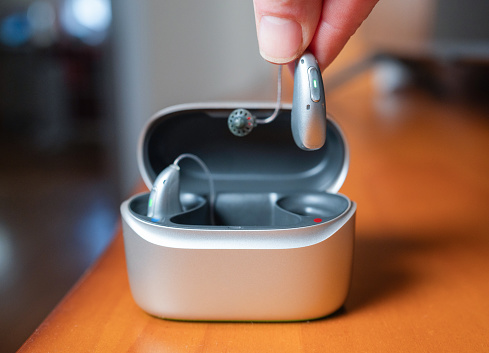
If one ear has no degree of hearing loss and the other has a loss significant enough to require a hearing aid, you will only need one device for the affected ear. Cases where one ear is exposed to loud noise or has a condition causing a physical blockage (acoustic neuromas, otosclerosis, etc.) are common causes of this discrepancy. However, many causes of hearing loss, such as aging, illness or genetics, will affect both ears.
Your brain is used to processing sound through both ears. If you develop hearing loss in both ears but only give one a hearing aid, you change the way your brain responds to sound, potentially resulting in the following:
- Difficulty understanding speech in noise. Background noise is a common struggle for people with hearing loss, but it can be even harder for those who only wear one hearing aid. In a crowded area like Gasthaus Bar & Grille on a Friday night, you rely on the volume in each ear to alert you to important sounds. If somebody talks to you from the side without a hearing aid, you will struggle to differentiate their voice from the louder noise.
- Trouble locating the direction of sound. When something on your right produces sound, the sound waves reach your right ear a fraction of a second before your left. Even though the time difference is imperceptible, your brain notices it and tells you where the sound originates. Dual hearing aids work to replicate this time difference, improving your sound localization abilities.
You may not realize how much you rely on speech-in-noise comprehension and sound localization until they start to fade. Luckily, modern hearing aids can help bring them back to life.
Schedule a Hearing Aid Fitting
Your hearing aid specialist will go over your degree and type of hearing loss to help you make the right decision about your treatment. Contact us at Ear, Nose & Throat Consultants today to schedule your appointment.